
Vedanta
A school of Indian philosophy that, drawing on the Upanishads, explores the link between the inner self and ultimate reality.
Do you think in the way of Vedanta? Answer 44 to 132 statements and see your affinity with every school and every thinker.
What it is
Vedanta asks what ultimate reality is and who we truly are. Drawing on the Upanishads, the texts that close the Vedas, it holds that there is an absolute reality, Brahman, and a deep self, Atman. In its Advaita, or non-dual, branch the two are one and the same: the feeling of being individuals cut off from the whole comes from ignorance, and liberation comes from directly knowing this unity.
Vedanta took shape over centuries in India through commentaries on the Upanishads, the Brahma Sutras and the Bhagavad Gita. Around the eighth century, Shankara gave Advaita Vedanta its classic form, travelling across India, debating other schools and founding monasteries. Later branches kept some distinction between the self and God. In the nineteenth century Vedanta reached the West and influenced writers, scientists and spiritual seekers.
Core ideas
- There is a single ultimate reality, called Brahman
- The deep self (Atman) is identical to Brahman
- Liberation comes from knowledge, not from ritual alone
Where to start reading
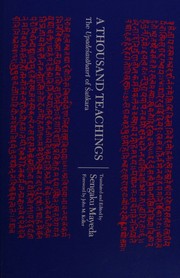
Each thinker's starter book, picked for beginners.
The thinkers
Where Vedanta stands on the 11 themes
Average position of the school's thinkers. Each theme runs from the first pole (−1) to the second (+1).
Neighboring schools
- Systematic metaphysicsThinkers who build complete systems about being, spirit and the meaning of reality.
- PlatonismA tradition that sees, beyond the world of the senses, a reality of eternal ideas such as the Good, Beauty and Justice.
- Christian thoughtPhilosophical reflection grounded in Christian faith, on God, the human person, evil, grace and the meaning of life.